I told someone about that on Tuesday.
Said in a corridor, to whoever was nearest. No record that it happened.
Now it's on the record the moment it's said.
Say it. Sorted.
Everyone says what they notice, as they notice it. SaySorted keeps regrouping the work around what is true right now: who is on, what cannot wait, and what belongs together.
A simulation of one morning. Press any moment to replay it.
Every time someone speaks
On the record the moment it's said, with the person's own words kept alongside.
Sent to whoever handles that kind of work and is on shift, in seconds.
Matched to every earlier report of that room and that thing, so a repeat stands out.
The problem
A hotel runs on things said in passing. Most of them never reach a screen, so nobody can see what was promised, or what keeps going wrong.
I told someone about that on Tuesday.
Said in a corridor, to whoever was nearest. No record that it happened.
Now it's on the record the moment it's said.
Who's dealing with 412?
Three people know a bit. The person in charge has to walk round and ask.
Now everyone can see who has it.
Didn't we fix that last month?
The same unit, the same fault, the eighth time. Nobody had the history to hand.
Now a repeat is spotted as it's reported.
How it works
Step 1
Hold the phone and say what's wrong, the way you'd tell a colleague. Two things in one breath is fine. If it's loud, type.
Step 2
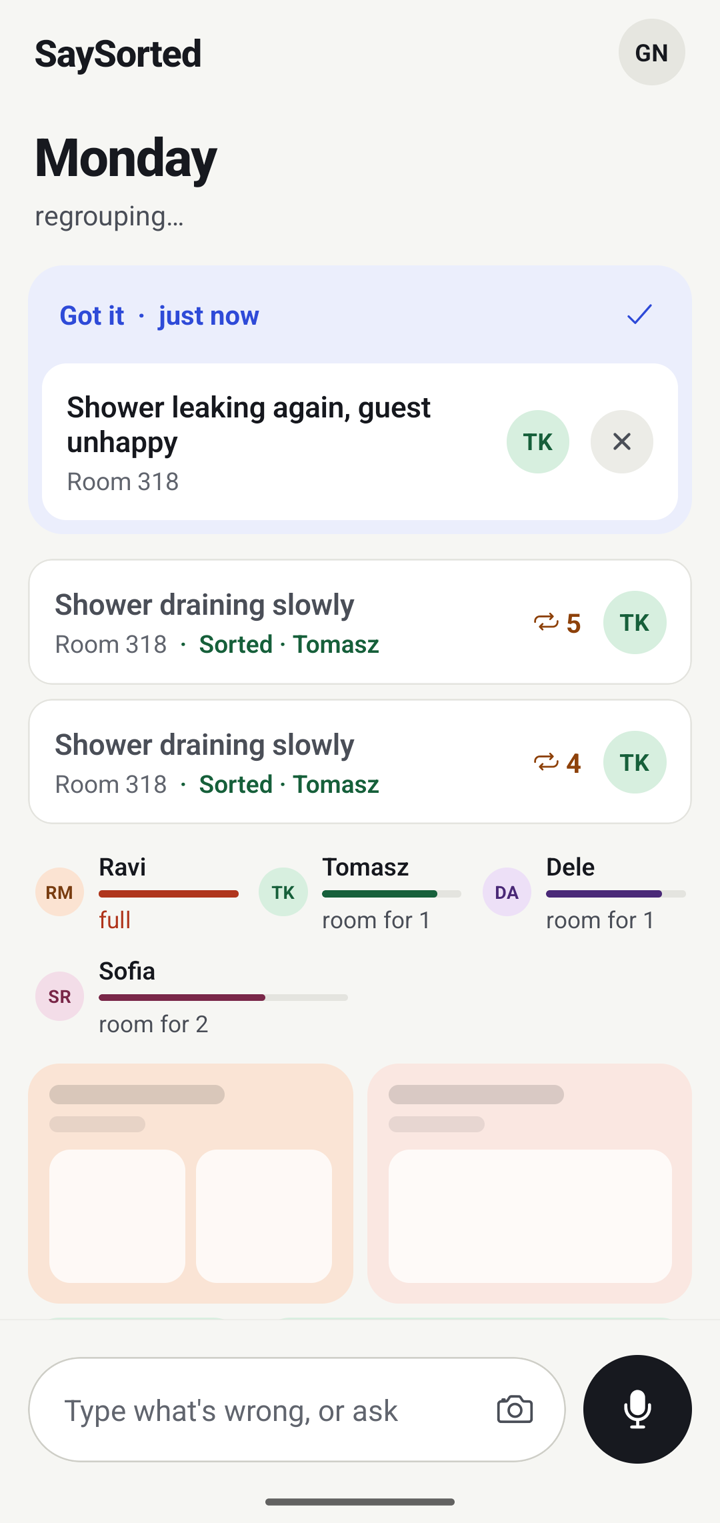
SaySorted works out what it is, where it is and how soon it's needed, then sends it to whoever handles that kind of work and is on shift.
Step 3
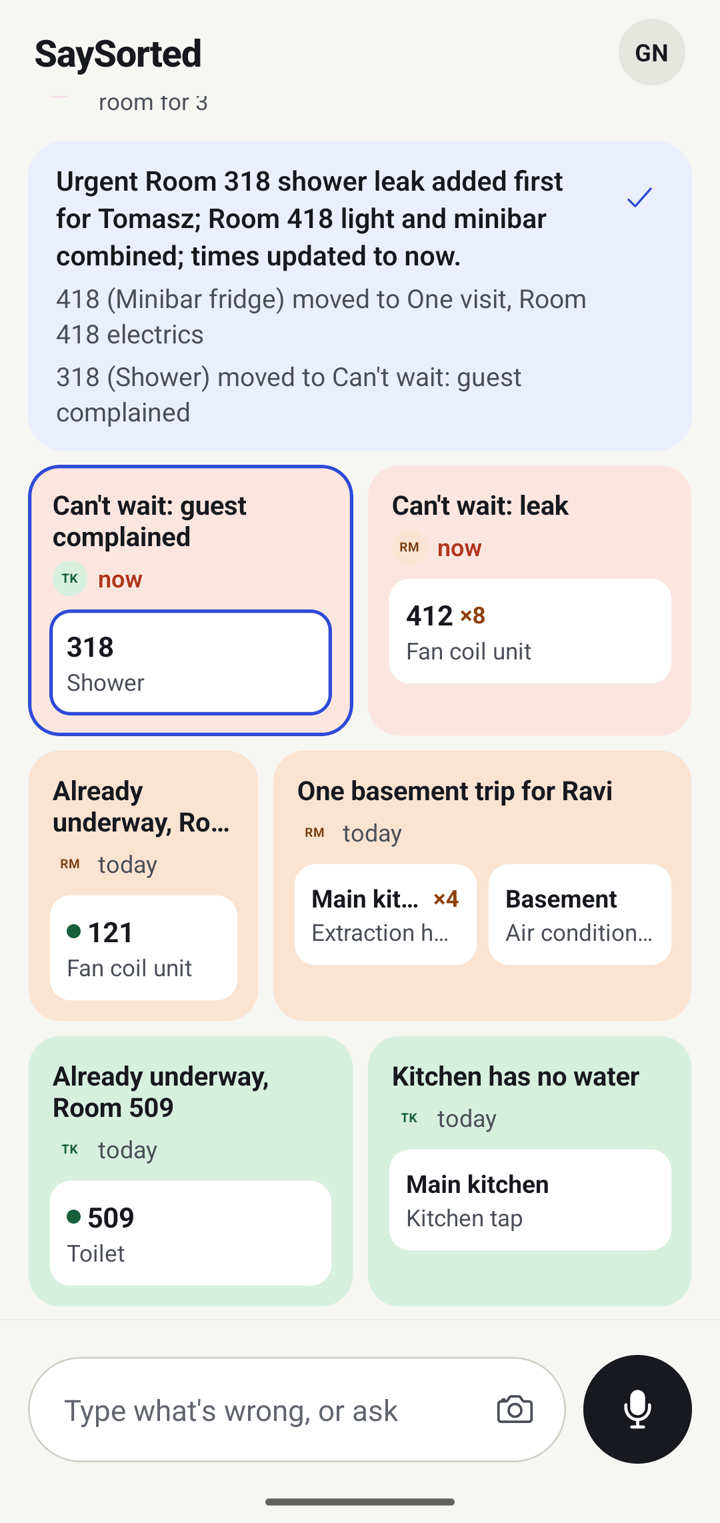
Whoever is in charge sees the whole day as groups of work that belong together: the same room, the same trip, the same deadline. When something new comes in, it regroups and says what moved.
Why teams like it
The staff who notice problems are rarely the ones at a desk. SaySorted is built for a corridor, a plant room and a busy front desk.
One sentence, spoken or typed, is the whole job. Where it is, what kind of work it is and who should have it are worked out for you.
“Again” means something here. Every report is matched to the history of that room and that thing, so repeats stand out.
A guest in the room, a check-in at three, a wedding on Saturday. Work is ordered by when it is really needed.
Said in Portuguese, read in English, answered in Arabic. The hotel keeps a single searchable history.
It sits in front of the system you already use and catches what never reached it. Nothing to replace.
“What's still open on the fourth floor?” “How many times has the AC in 412 gone?” Answered from your own records.
Who it's for
Say it as you leave the room and carry on. See that it was picked up, in your own language.
Your work for the day, in an order that makes sense, with what was done last time.
Know who has what, right now, without ringing round. Move things with a tap or a sentence.
See what keeps going wrong, and where, from records that write themselves.
What it won't do
Your people know their jobs. SaySorted records, routes and remembers. The decisions stay with you.
Questions
No. SaySorted is where things get said and recorded. It works alongside your existing system, and on its own if you don't have one.
Very little. If someone can say “the shower in 318 is leaking”, they can use it. There are no forms or categories to learn.
Each person speaks or types in their own language, and gets their answer in it: English, Spanish, French, Portuguese, Arabic, Hindi, Chinese and more. The hotel keeps one record.
Everything it records is shown straight back to the person who said it, who can remove or correct it. Whoever is in charge can move anything with a tap, and undo a regrouping.
Hotels are where we started, because so much gets said on the move. The same idea fits any team that works on its feet.
We're setting up pilots with a small number of hotels. Write to us and we'll arrange a walkthrough with your team.
See it with your own team, on your own floors. We'll set up a pilot and stay with you through it.
Book a pilot